
Outdoor life and recreation on its way into Heureka
Decision support
Which type of forest do Swedes enjoy the most? The answer can be found in a study from SLU that will shortly be published. The results show that a mature forest with good paths is the most popular – and that people with a strong connection to nature are less fussy. These insights will now be used to integrate social values into decision-making support for forest planning.
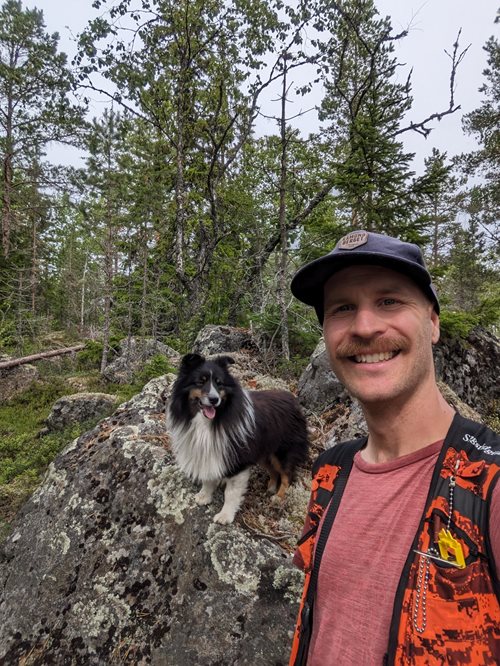
One year into his PhD studies, Victor Göransson has formed an initial picture of what makes Swedes appreciate a visit to the forest – and what acts as a direct deterrent. The aim is to make social values such as outdoor life and recreation measurable and, in future, to integrate them into Heureka. Heurika being the most widely used decision-support tool for forest planning at stand and landscape level. A recent study was conducted within Mistra Digital Forest and carried out under the direction of SLU. In the study, 1,500 people from across the country were asked to complete a questionnaire about their relationship with the forest, and how they experience different forest environments.
– I want to incorporate outdoor activities and recreational values into forest planning, primarily due to the positive impact that spending time in the forest has on public health. The study shows that we prefer airy, ‘tidy’ forests with mature trees, to ‘messy’, recently thinned forests or to dense, young forests. But what is really interesting, is that footpaths have a positive effect on the experience regardless of the type of forest. Accessibility is extremely important for forest visitors, says Victor Göransson, a PhD student in forest planning at SLU.
Unique perspective captures the Swedes’ connection with nature
There are significant differences in how individuals experience the forest. To understand why, the study borrows the concept of ‘nature connectedness’ from environmental psychology. This perspective, which is unique in this context, captures the extent to which we experience ourselves as a part of nature. The correlation is clear: the stronger our connection to nature, the more we relax in the forest, and the greater our tolerance of different forest conditions.
– Nature connectedness captures our different experiences of the forest in a way we have been unable to describe before. These findings become particularly interesting when we link them to urbanisation, for example. We are spending less and less time in the forest, and have fewer opportunities to build that sense of connection with nature. In many people’s eyes, the forest is becoming less attractive, and we are less able to recharge and recover there. It becomes a negative, downward spiral, says Victor Göransson.
Variations in the landscape enhance the experience
So far, the focus of the study has been limited to individual forest stands or sites. The next step is to incorporate the landscape perspective, something Victor Göransson finds particularly interesting for a forestry sector that affirms social values.
– As forest visitors, we are often on the move; we pick mushrooms, we walk or run, and the forest experience is enhanced by variations in the landscape. A recently felled area, which many find intrinsically rather dreary, is not as disturbing if it is followed by a mature commercial forest. Since 80 per cent of all forest visits occurs in the vicinity of built-up areas, it is primarily these locations where consideration of social values such as recreation and outdoor life plays a role, Victor Göransson concludes.